Articles
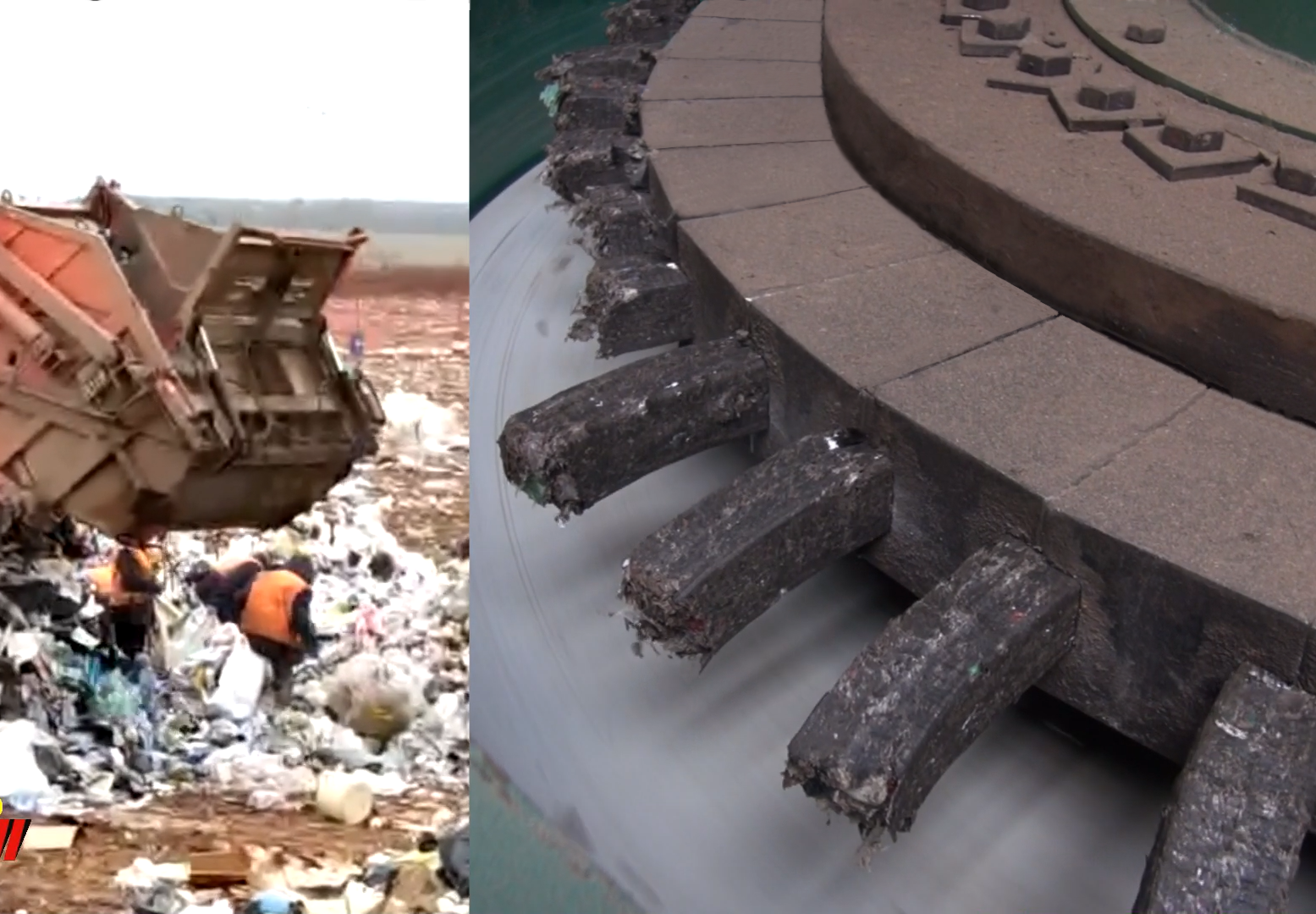
Disposal of solid waste by briquetting method
Some solid waste statistics – Global landfills receive more than 2 billion tons per year.
– The amount of waste in Ukraine’s landfills is 12.5 billion tons, of which about 1 billion tons is MSW.
– The USA is the leader in MSW production – 700 t/day.
– The leaders in waste processing are Sweden and Germany, which recycle about 90% of the amount of waste generated, Sweden even additionally buys from Norway, since the facilities processing MSW are loaded at less than 100%.
– Russia processes 4-5% of the total amount of MSW.
– There are no statistical data on Ukraine.

The composition of solid waste and the processes taking place at solid waste landfills
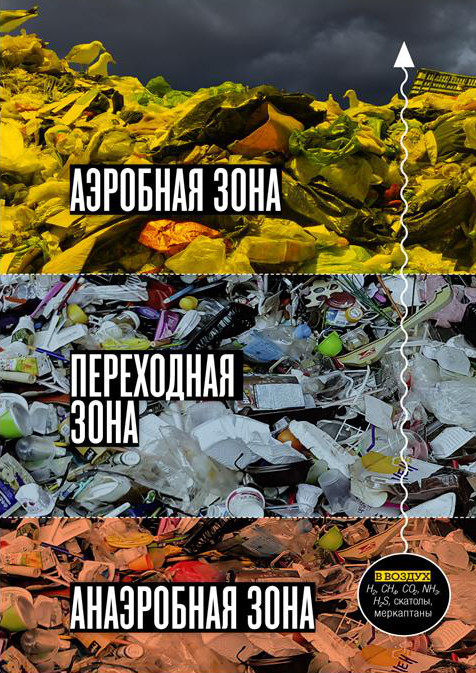
Aerobic (youngest) zone of the landfill – its depth is 1.5–2.5 m. Here, all processes take place with the participation of oxygen: product residues rot, organic acids are formed, which dissolve metal debris. Aerobic bacteria multiply, rodents and insects multiply. From the aerobic zone of the landfill, the wind blows dust from the surface, and with it – heavy metals, microorganisms, etc. Salts of heavy metals seep into deeper horizons.
Anaerobic zone – various destruction processes take place here, as a result of which toxic gases are formed – carbon dioxide, ammonia, hydrogen sulfide, skatole and combustible gases – hydrogen and methane. Landfill gas diffuses into the upper layers of the landfill and escapes to the outside. In the transition zone, it converts nitrates to toxic nitrogen oxides. Heavy metal ions penetrate into soil and underground water. The soil is infected with anaerobic bacteria – the causative agents of tetanus, jaundice, and tuberculosis.
If the landfill catches fire in the depth of the garbage heap, it is very difficult to reach such a fire to extinguish it: the fire may be too deep. Due to the lack of oxygen during deep combustion, toxic polyphenols, dioxins, etc. are formed.
Consider the composition of waste. What can be recycled without much difficulty after sorting is metal, glass, PET plastic, paper and cardboard. These materials make up about 6-8% of the total mass. The most unrecyclable material is sifting, stones, construction waste, because this material is difficult to separate from the general mass, although there are methods of separating the sifting.
Many plants produce sorting complexes for solid waste. What to do next after sorting, having selected 8% of waste?
Organics are proposed to be used as fertilizers on agricultural fields. I believe that this is an absurd proposal because firstly, it is financially unprofitable. Organic matter is a soil improver rather than a fertilizer, and has a high consumption rate of 40 tons per hectare. One can only imagine what the cost of introducing such organic matter will be. Secondly, the acidic and chemical composition of the soil will be disturbed. And, thirdly, uncontrolled processes during the fermentation of organic matter do not exclude bacterial contamination of the final product. As a result, we achieve a negative result.
It is also believed that all plastic can be sent for recycling. It does not. MSW contains such plastics as polyethylene, polypropylene, polystyrene and a number of others, which are not suitable for recycling without separation, because have different chemical and physical parameters, and it is impossible to separate them.

Our company “Zerma-Ukraine” has been dealing with this topic for 6 years. We manufacture equipment for compacting sorted waste into fuel briquettes 32×32 mm in size.
Our machines successfully work with waste disposal, serving the Kyiv Cardboard and Paper Plant and the Poninkiv Cardboard and Paper Factory, and also work at other enterprises, disposing of agricultural waste. In September, we concluded a contract with the well-known company Circom Ltd. for the supply of such machines to England for compacting solid waste.
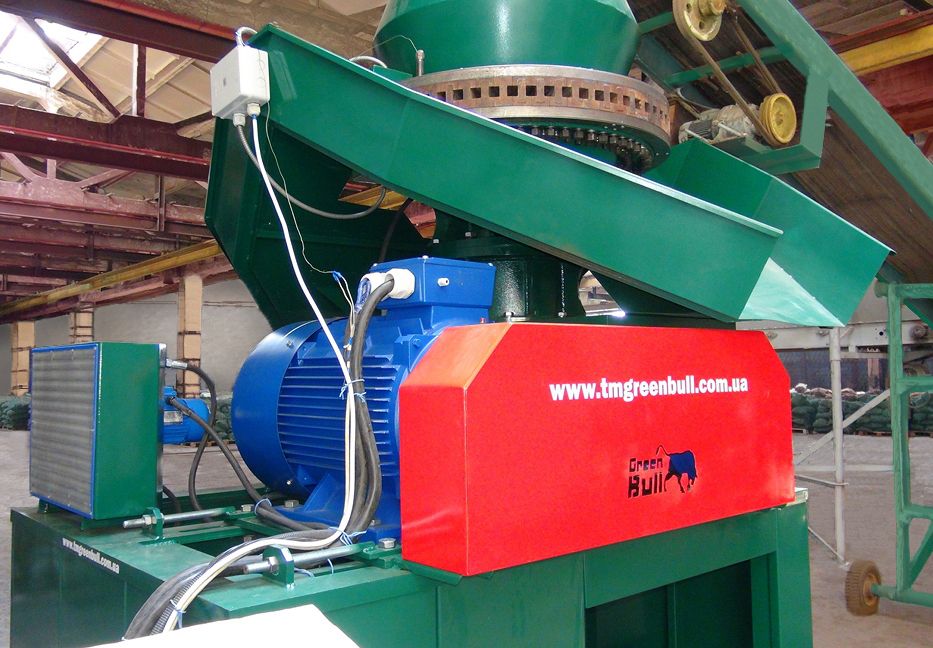
The range of our machines by productivity ranges from 1.5 t/h to 8 t/h. Productivity depends on the composition of raw materials and the model of the machine. The main difference between machines by model is the number of forming matrices from 45 to 90 pieces and the power of the main engine from 55 kW to 160 kW.
For reliability, the briquetters have an oil cooling system and an automatic bearing lubrication system. Bearings are installed by the SKF brand. Matrices have tungsten carbide coating. The electrical control cabinet is assembled on diode starters, a 15″ contact monitor for ACS is installed on the front panel.
Such machines can process both solid waste and industrial waste and agricultural waste.
Everything would be great, but there is one “but”. When plastic burns, it emits poisonous substances – dioxins and sulfur oxides and others. There are two solutions to this problem.
The first is the installation of special filters after the incinerator, which cost from 5 million dollars.
The second way is to burn briquettes in special furnaces with a combustion temperature of over 11,000C. These are furnaces of various designs with double firing. After the first chamber, oxygen with plasma treatment is supplied to the flame. Or rotating combustion chambers are used, as they do in Finland, Turkey and other countries.
All over Europe, you can burn plastic waste at cement plants because there, in the incinerators, the temperature reaches 13,000C and the solid waste remains in the flame for more than 2 seconds.
The English company Circom uses solid waste briquettes in pyrolysis gasifiers with a temperature of 13000C, and the gas obtained is used to generate electricity. Also, as an example, you can consider the gasifiers of the American company adaptiveARC, which use the plasma arc method.
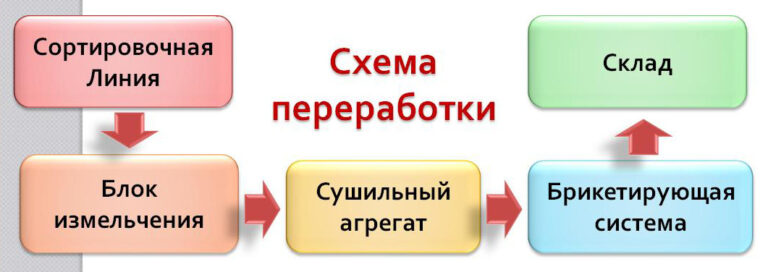
The recycling scheme we offer
This equipment is not cheap, its cost is from 600 thousand dollars for the interval from the sorting line to the furnace, depending on the productivity.
Financial value will appear only under the condition of state support. Moreover, investments from the state and local councils are not required.
To do this, it is necessary to determine who disposes of solid waste landfills.
Adopt the law in accordance with draft law No. 4835-d, which was submitted to the parliament by a group of People’s Deputies of Ukraine back in 2017. Introduction of a green tariff for electricity obtained as a result of solid waste processing.
In this case, private investments will make sense.
Also, MSW fuel briquettes are a worthy substitute for coal at the CHP, provided the furnaces are modernized. Thus, the Kyiv Cardboard and Paper Mill is considering the installation of a 7 MW Turkish-made furnace for its own needs using its plastic waste.
Our government and people’s deputies urgently need to solve the issue of solid waste and industrial waste. We understood the problems of garbage on the example of Lviv, Drohobych, Kherson and other cities of Ukraine.
I propose to include a certain group of industrial waste in draft law No. 4835-d.
There are many opinions regarding the expediency of MSW incineration from the point of view of environmental safety. On one scale, this is the pollution of air and groundwater with dioxins, the causative agents of diphtheria, tuberculosis, tetanus, hepatitis and other bacteria, as well as more than 11 million tons of methane per year, which is emitted into the air by global solid waste landfills. All these negative phenomena cannot be stopped if we do not actively process solid waste.
On the other side of the scales is incineration, which releases dioxins and sulfur oxides and other poisonous substances. But during combustion, the release of harmful substances can be reduced to an acceptable minimum, provided that the necessary technologies are followed.
In our country, there is no laboratory equipment for determining the amount of harmful substances in exhaust gases. Small companies should not engage in MSW incineration. And large companies can invite foreign specialists to obtain a certificate, but all this is subject to the financial feasibility of processing MSW.
Later, such laboratories will also appear in Ukraine. Demand always creates supply.
Once again, we rest on bill No. 4835-d. It is necessary for competent specialists to study this issue and give their scientific conclusion based on the global experience of solid waste processing.